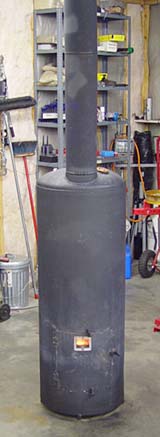
Roger Sanders' Waste Oil Heater


Roger Sanders has solved all the problems that make Mother Earth News waste oil heaters difficult to use. His new MEN heater design is simple, reliable and easy to use, it's quiet and uses no electricity, it has reliable oil flow and a wide heat range, it's easy to light and easy to clean. "In other words, it is a practical design that you can use day in and day out for seriously heating your dwelling or workshop without costing you a lot of time and frustration."


Problem 1: Cleaning
Problem 2: Low-heat operation
Problem 3: Oil flow stability
Construction suggestions
Burning vegetable oil
Summary
Frequently Asked Questions
-- Can I use a waste oil heater to heat water or heat my house?
-- I'm having trouble starting my heater, what should I do?
-- Where can I get a conical burner and precision needle valve assembly?
-- Where can I get a nice oil filter like that shown in the article?
-- What about smoke, odor, and soot?

I built a Mother Earth News Waste Oil Heater (MEN heater) to heat my repair and machine shop where the heater gets used all day, every day, for about eight months of the year. The MEN heater works as claimed and puts out a lot of heat. I was pleased to find that I could use waste-oil to successfully heat my shop.

However, after using the MEN heater for several months, I became so frustrated with its problems that I concluded that it is unsuitable for serious, regular use. So I embarked on a journey to design and build a more practical heater.

There are three big problems with the MEN heater. These are:

Problem 1: Cleaning

Cleaning the MEN heater is a major hassle. Burning waste motor oil leaves deposits in the combustion chamber. Calling these deposits "ash" is deceiving as they can be as hard as concrete and just as hard to remove.

Experience reveals that there are actually several different types of deposits. These can be broken down into two basic types that I'll call "ash" and "coal."

"Coal" deposits are dark gray (almost black) and appear much like unburned charcoal. These deposits are very hard and must be chipped away from the burner surfaces using a hammer or cold chisel and hammer. They form on the hot metal surfaces inside the combustion chamber where the oil changes state from a liquid to a gas (vaporization).

"Ash" deposits are crusty, light, airy, and are easy to wipe away with a gloved hand or putty knife. They mostly are light in color, ranging from tan to light gray, although some are black.

For easy cleaning, "coal" must be avoided at all cost, only "ash" must remain to be removed. Vaporization heaters (like the MEN heater) must be cleaned every 6 to 50 hours of operation depending on the oil used, the contaminates present, and how hard you run the heater. If you use your heater every day, all day, this means that you'll have to clean your heater every morning when you light it for the day.

This cleaning ritual is a serious problem with the MEN heater due to its complicated burn chamber. There are many parts and some of them have rounded surfaces, which make them hard to access for cleaning, and they are bolted together. The heater produces heavy "coal" deposits.

The nuts and bolts inside the MEN heater's combustion chamber become encrusted with coal, making them difficult to unscrew. Once the parts are separated, it is necessary to use a chisel and usually a hammer to break away the coal.

Its rounded surfaces are hard to clean because a hammer, putty knife, or chisel only contacts a small area, which forces you to spend a lot of time cleaning small spots and the parts must be constantly turned to expose new areas to clean. It is much easier and faster to clean flat surfaces. It is necessary to use a drill to clear out the holes in the burner. This dirty, messy, time-consuming, and frustrating task gets old very quickly.

Others have tried to deal with this problem, like Bruce Woodford. I tried Bruce's forced-air heater, which uses a simple combustion chamber filled with loose bolts to make it easier to clean.

This is a simpler design than the original MEN heater, and it is more efficient. It was easier to clean too. I give Bruce high marks for his design. But there were still problems.

Shaking the bolts as recommended did a fine job of removing the ash, but the bolts were also coated with coal, and shaking them did not completely clean them. Eventually you have to beat on them with a hammer to break the really hard deposits free, and this was very time-consuming and difficult as they are hard to hold and have rounded surfaces. An easier solution is to replace the bolts, but large bolts are expensive. The cylindrical burner also became coated with coal, and because access to the inside is very limited, cleaning it was difficult.

Another issue was that fishing the loose bolts out of a pile of ash was a messy business. Setting the bolts back into place in the combustion chamber was a fiddley job that tried my patience. I didn't like the noise and complexity of using an electric blower. The heater would not run reliably at low heat settings.

All this frustration finally compelled me to design my own combustion chamber and heater. Conceptually, vaporization heaters are very simple and easy to design. They work by vaporizing liquid oil upon a hot metal surface. The vapors are flammable, and when mixed with adequate amounts of air, they burn hot and surprisingly cleanly. But making a design that doesn't produce coal is very challenging.

The heart of the problem is that as oil evaporates from the hot vaporization surface, it leaves behind all the "sludge" from the oil that will not vaporize and burn away. This sludge is turned into a hard mass by the heat of the burning oil. I found that pure, clean, new, oil hardly leaves any deposits at all, but used crankcase oil is full of contaminates, detergents, and various additives, which remain behind as nasty deposits.

This problem is much like boiling water in a pan or teapot. As the water changes to steam, the minerals in the water are left behind in the pot. These minerals form hard deposits in the pan that are difficult to remove.

Commercial waste-oil heaters partially solve this problem by atomizing the oil through a nozzle rather than vaporizing it. The contaminates are atomized as well, so they are not left behind in the nozzle. As the atomized oil burns, the contaminates fall to the bottom of the combustion chamber as "ash" where they are easy to remove.

But atomizing heaters have other, major problems. They require compressed air to atomize the oil, the oil must be pumped, precisely pre-heated, very well filtered, the nozzles tend to clog with carbon, low heat operation is not practical, and the pumps, nozzles, and air compressors add a lot of complexity and maintenance issues. Also, they use large amounts of electricity, which is expensive and defeats the idea of using "free" fuel and being environmentally responsible.

I like the simplicity, silence, and economy of a vaporization type waste oil heater, so I focused my attention on making one that is extremely simple, noiseless, requires no electricity, that produces mostly soft ash rather than hard coal, and has only flat surfaces that are easy to clean.

I have designed, built, and tested dozens of burners as I tried to develop an ideal combustion chamber. There isn't time in this article to describe all the details, changes, and experimentation involved. So I'll just summarize my findings and describe the burner that solves the problems.

After considerable experimentation, I eventually settled on the idea that the simplest combustion chamber was just an open "pot" into which the oil would drip, vaporize, and burn. I tried various types and sizes of pots, with and without various types of internal assemblies, and found they all could be made to work. Of course, some worked better than others and I found an 8-inch cast iron pot to work quite well. The nice thing about an open pot is that it is only a single part, does not require any disassembly, and can simply be lifted out of the stove for cleaning.

But no matter how I made my burn pots, they all produced large amounts of coal deposits that were hard to clean. But at least they presented a relatively simple surface to clean and there was no disassembly required, even though they required a hammer and chisel to clean them well. I was not satisfied so continued to search for a better burner.

After more head-scratching and study, I came up with the idea of using a LIQUID vaporization surface instead of a solid, metal one. I reasoned that vaporizing the oil off a liquid surface would leave the contaminants behind in the liquid or they would blow off the liquid where they would be soft and easy to remove. In either case, there would be no hot, solid, metal surface that could form coal. This insight turned out to be the key to easy cleaning.

But how could I make a liquid vaporization surface? Initially I made a shallow metal cup 4" in diameter (10 cm) and 3/4 of an inch deep (2 cm) into which the dripping oil would pool. The cup was in the form of a shallow cylinder with a flat bottom. I made it by welding a 1/4-inch thick steel plate (6.5 mm) to a 3/4-inch long section of 4-inch steel pipe. I placed this inside the 8-inch diameter (20.3 cm), cast iron pot that I had been using as my burner. I figured that the oil pool in the cup would release vapors into the pot where they would burn. Since no liquid oil would enter the pot, there would be no coal formed in the pot. But I found that things worked a bit differently than expected.


Photo #1
The oil dripped into the cup where it boiled and oil vaporized as expected. But as air flowed over the surface of the oil, it mixed with the oil vapors, and burst into intense, white-hot flame directly over the top of the oil pool. Photo #1 shows the flames over the oil pool as seen through the heater's air tube. No oil vapor entered the pot, no burning occurred within the pot, so the pot was not even needed. This simplified the design even more.

Initial tests of this cup were promising as the deposits were mostly ash and very easy to remove. However, some coal formed on the top edge of the rim of the cup that extended above the oil pool. Ideally I needed to modify the cup to eliminate this trouble spot.

But there was a much bigger problem, which involved the rate of oil flow. If only a small amount of oil was dripping into the cup, it vaporized completely and eliminated the oil pool, which resulted in those dreaded coal deposits. If I ran too much oil into the cup, it overflowed, the oil spilled out into the pot, and the pot got coated with coal. In short, it was difficult to find an oil flow that kept the oil in a liquid pool that didn't overflow the cup. In any case, there was only one heat level possible and I had no way to control the heat output.

After more head-scratching, I figured out that what I needed was a cup whose area increased as the oil flow increased. The increased oil pool area would make it possible to vaporize more oil without it overflowing the cup.


Photo #2
I developed a cup that did exactly that. I built a shallow, 5-3/4 inch diameter cup (14.6 cm) whose interior surface was in the shape of a shallow, inverted cone or funnel of 12 degrees. This also allowed me to eliminate any lip that could accumulate coal. Photo #2 shows this conical burner.

This conical burner design allowed excellent heat control. When only a little oil was being introduced into this new burner, it would form a pool about an inch in diameter (2.5 cm) in the middle of the cone that burned very hot. When a lot of oil was fed into the burner, the oil pool expanded out to 4 or 5 inches in diameter (10-12.7 cm), producing much more heat output. The size of the oil pool was self-regulating and assured that there was always a pool of oil present that never overflowed the burner as long as the oil flow was kept within reason.

This design allowed me to obtain excellent heat control over a very wide temperature range. I could get huge amounts of heat or turn it down to where the heater was just barely warm. Since the burning occurs over the top of oil pool, the pool is always extremely hot and burns cleanly, even at very low oil flows. It is like using a large combustion chamber for high heat and a small one for low heat. As a result, the heater burns very efficiently and uses a minimum of fuel for any given heat setting.


Photo #3

Photo #4
This combustion chamber is incredibly simple and is quick and easy to clean. Cleaning takes only seconds as all you need do is lift the burner out of the heater and scrape its flat conical surface with a putty knife. Photo #3 shows the burner after it has been run all day. Photo #4 shows the burner after passing a putty knife over one side. The ash just falls away effortlessly.

Soot is formed in the flue and inside surfaces of all oil heaters. This soot is self-cleaning as it gradually flakes off the inside surfaces and the flakes fall to the bottom of the heater where you can easily remove them. You don't have to clean them out often as you can wait until they get several inches deep. With the MEN heater, you not only have these soot flakes to remove, but you quickly accumulate a lot of paper ash that is used in the lighting process.

My heater does not use any paper, so has no paper ash. Considerable ash is blown off the conical burner rather than sticking to it, which is nice because this ash falls into the bottom of the heater where it mixes with flakes of soot that fall from the flue. Photo #5 shows soot and ash in the bottom of the heater. Any ash that falls to the bottom of the heater represents ash that does not accumulate on the burner and does not have to be cleaned off the burner.

About once every month or two, I remove this debris. It is not attached to any surface and weighs nothing (much like wood ash), so it is very easy to remove. I use a small, hand-held, garden shovel to scoop up the ashes and put them into a trash can. A vacuum cleaner works very well, but cleaning a vacuum full of soot is messy, so I prefer using the shovel.


Photo #5
To make this cleaning easy, do not put any sand or gravel in the bottom of the heater as is recommended for the MEN heater. Just leave the bottom of the heater bare steel so you can use the shovel without picking up any sand.

Problem 2: Low heat operation

Using an oil pool as a vaporization surface solves the second major problem of the MEN heater, and that is low-heat operation. The MEN heater produces a lot of heat and requires a rather brisk oil flow where the oil falls in a steady stream rather than in drops. It has a large vaporization surface that must be kept hot for efficient operation. This makes it impossible to run the heater at a low heat setting, which often is needed in mild weather conditions.

By comparison, the flame in a conical oil burner will withdraw to operation only within the center of the burner where the heat remains intense. This allows the heater to be run on a very low heat setting as only a slow oil drip (just a couple of drops per second) will still result in excellent flame stability and efficiency. In other words, the fire stays hot and efficient, but its size is smaller.

When turned down to a low setting, the oil flow can be reduced to only a few ounces per hour, which burns less than a gallon of oil per day. (1 US fluid ounce = 29.6 ml.) When the heater is running on "high", it can burn about one gallon per hour (3.78 litres).

An additional bonus is that lighting this heater is much easier than the MEN heater. You do not need paper, wood chips, or Perlite. You do not need a two-stage lighting process where you light the paper first to start the draft then light the burner. All you need to do is fill the burner with kerosene (about 1-1/2 ounces, 44 ml) and light it. Close the door, turn on the oil, and walk away. The heater will establish a draft automatically as soon as you close the door and the flame will be self-sustaining immediately.


Photo #6
Photo #6 shows the burner just after being lit. Note that the flames are going up at this point. But when you close the door, the draft will start and fresh air will be drawn down the air tube that is directly over the burner. This air will force the flames to move horizontally and extend radially out from the center of the burner forming a "flower of flame" that will get the walls of the heater extremely hot.

Some minor issues have to be addressed when using a conical oil burner. One is excessive air flow velocity. If the air comes in too fast, it will blow the vapors off the pool of oil and the heater can "flame-out."

You need plenty of air for efficiency, but you have to keep the velocity low. After considerable experimentation, I found that you must use a large air tube (the 4-inch tube used in the MEN heater is fine), but you must use a restrictor at its inlet to keep the velocity low.

The restrictor I use is just a thin metal plate that has a 2-inch hole in it (5 cm) that sits at the entrance to the air tube. Photo #7 shows this plate.


Photo #7

Photo #8
This looks professional, but is hard for DIYers to make. An option that works just as well is a 2 x 4 inch, rectangular piece of metal that you lay across the intake tube so that about half the opening is obstructed. Photo #8 shows such a plate.

Note that I do not use an air pipe pre-heater like the MEN stove. It just isn't needed. My air pipe starts at the top of the heater and ends about 8 inches above the oil burner (20.3 cm). It gets very hot from the fire inside the heater, and since the air flows through the pipe slowly, the air has adequate time to get hot.

Problem 3: Oil flow stability

Oil flow stability is a problem with all gravity-fed, waste-oil heaters. This is because the viscosity of the oil changes dramatically with temperature. The MEN heater is extremely troublesome in this regard because it runs the oil feed line around the hot flue pipe. This is a mistake.

Why? Because having the oil line in contact with the flue heats the oil in the line as the stove gets hot. This reduces the oil's viscosity causing it to flow faster through the oil control valve. The increased oil flow causes the stove to get hotter, which causes the flue to get hotter, which causes the oil in the pipe to get hotter, which reduces its viscosity further, which causes it to flow faster, which causes the stove to get hotter, which reduces the oil's viscosity more, which causes it to flow faster, etc.

What you get is a positive feedback loop, which causes the heater to get too hot and the oil flow to become excessive. So after a few minutes, you have to turn down the oil flow, which reduces the heat in the flue, which increases the oil's viscosity, which reduces the oil flow, which reduces the heat, etc., until the fire goes out -- unless you turn the oil flow back up again, which causes more heat, more oil flow, etc. In short, the heater's operation is inherently unstable and unreliable. This problem requires you to constantly monitor and adjust the oil flow every few minutes.

Oil flow stability is essential and it is impossible to attain as long as you have this positive feedback loop problem. To reduce the problem, keep the oil feed line as far away from the flue as is practical so that the temperature of the feed line remains relatively constant.

As the room heats up, the oil in the line will still become slightly less viscous and the flow will increase slightly, which may require you to adjust it. But once you get the room at the temperature you want, the oil flow can be set to maintain that temperature and it will be stable for a long period of time -- usually all day, unless the outside temperature changes significantly, which affects the flow of oil from the outside tank.

The above change helps a lot, but doesn't completely solve the problem. Two additional things are necessary to achieve truly stable oil flow. First, it really helps to use a relatively high oil pressure. I eventually put my oil tank on a hill above my shop, which give me a thirty-foot head of pressure. The increase in oil pressure compared to having a tank just a couple of feet above my heater significantly helped stabilize oil flow. While this added pressure makes adjusting the oil control valve more sensitive, the oil flow stability was very much improved.

The other major problem associated with oil flow stability is that the typical "needle" valve found at hardware stores is not designed to precisely control the flow of liquids. These valves are really designed to just be small on/off valves. I found that these valves gave me only one-eighth of a turn between minimum and maximum heat on my heater. They need to be much more gradual in their operation.

If you carefully inspect one of these valves, the reason for their poor performance will be obvious. They are very crude and don't even have a tapered needle in them as is necessary to precisely control flow. They are built using the flat end of the shaft to cover or uncover an orifice. And the orifice is about 3/16-inch in diameter (5 mm), which is much too large for our use. As a result, just a tiny amount of shaft rotation results in a relatively large increase in oil flow.


Photo #9
At the top of Photo #9, you can see the valve assembly. Below that I've placed the control shaft, showing that it has a flat end. Below that, I've placed a proper "needle" valve shaft.

As if the lack of a needle valve isn't enough of a problem, the threads on the flat-end shaft are very loose and sloppy, which means that the valve will not necessarily be in the same position with regard to the shaft's rotational position. As a result, you can't get reproducible flow settings based on the position of the control shaft. This problem could be improved if a strong spring were used to hold tension on the threads, but these valves have no such spring.

If you use one of these valves, you can improve the reproducibility of the settings by always adjusting the valve in one direction only and pushing in (or pulling out) on the shaft the same way every time you rotate it so you maintain a stable position between the threads. The valve settings will still not be completely reliable and reproducible, but you will get some improvement.

The only real solution to this problem is to use a valve that uses a tapered needle with precision threads and a spring to assure that the threads remain in the same relative position to each other. I modified my valve by using a long, tapered needle and only a 5/64 inch orifice (2 mm). I now have a full turn between "low" and "high" and I can rely on the oil flow being consistent wherever I set the knob. The only thing that alters the oil flow now is ambient temperature, but this only has a very small effect on oil flow.

The oil drip pipe that ends above the burner should be smaller than the 1/4-inch copper tubing (6.5 mm) that is usually used. When such large tubing is used, the oil comes out in big drops that cause relatively large waves as they drop onto the oil pool's surface. This disrupts vaporization to a significant degree when the heater is first started and not very hot. When this happens, it can cause the heater to flame-out.

Therefore, I silver-soldered a 3/32-inch diameter brass tube (2.5 mm) into the 1/4-inch main feed tube. This makes very small drops that do not significantly disrupt the oil pool surface. Note that you cannot use regular lead-based solder inside the heater as it spontaneously melts from the heat. You must use silver solder.

I installed a mica window in the door of my stove. This is a nice feature as you can see the flame, but it is practical to just observe the flame by looking down through the air pipe. By observing the flame and using a wood stove thermometer, you will quickly learn how your heater is working.

You will need a good filter to prevent your oil control valve from getting clogged up. Filtering the oil through panty-hose is not good enough. So I bought a commercial filter/water-separator that uses a cleanable, 80-mesh, stainless steel screen. This was well worth the $80 cost.


Photo #10
Waste oil always has water and/or antifreeze in it. Even if nobody put antifreeze in it, it will always have water mixed with it as water is one of the products of engine combustion. The water will be mixed into the oil as an emulsion, so it will not just settle to the bottom of the tank where it can be drained away just one time. The filter screen causes the water to separate from the emulsion, so you will have to drain water frequently, usually daily as part of your start-up ritual.

If there is antifreeze involved when you get a new tank of oil, you may have to drain water several times over a few hours until most of the antifreeze that quickly settles on the bottom of the tank is gone. Then draining water daily is sufficient. In any case, you will be draining water frequently, so you need to make it fast and easy.

To do so, I put a quarter-turn, ball valve in the bottom of my water separator. I installed a clear hose at the outlet so I can see when the draining water turns to oil. Photo #10 shows this filter assembly.

Experience is the toughest teacher -- she gives the test first, then the lesson. So another issue I learned the hard way is that your oil feed line must drain downhill at all times until it reaches the water/oil separator. If there is any low spot in the line, it will accumulate water, freeze, and prevent stable oil flow. I originally put my oil line on the ground and then ran it up the side of my shop where it made a very neat installation. But this formed a low spot at the bottom of the wall, and this ruined my oil flow. I had to elevate the line to get stable operation.


Photo #11
Photo #11 shows this suspended line. It isn't as neat as running the line on the ground, but it works perfectly.

It is interesting that nobody seems to mention the issue of collecting oil. This is a major problem as you will burn quite a lot of it over time. You can expect to use 50-100 gallons per month (190-380 litres) during sub-freezing weather if you are heating a significant space (my shop is 1,200 square feet, 111 square metres), and so you must have a fast and effective way to collect and store oil.

Collecting oil is a messy hassle, so you don't want to have to do so any more frequently than necessary. In short, you want a big oil tank.

There is no cheap and easy solution to this problem. I considered 55-gallon oil drums (200 litres), but when full, these are heavy, hard to handle, and a nuisance to connect a feed line to without spilling oil and making an environmental mess. I quickly realized that I needed a serious oil transport and storage system.


Photo #12
While my heater cost me nothing to build from scrap parts, I had to spend about $500 to build a tanker/trailer and pump system for my car. This consists of a small, inexpensive ($200) trailer kit (from www.northerntool.com or www.harborfreight.com) to which I mounted a 225 gallon (850 litres), plastic tank ($220). Photo #12 shows this tanker/trailer.

When this tank is full of oil, the gross weight of the tanker/trailer is about 1,400 pounds (635 kg), which is the maximum weight I care to pull with my car and it is the maximum weight allowed by most small trailers. So don't get a tank that is too big unless you have a big, powerful tow vehicle and a larger trailer that will handle the weight.

You also need some sort of hydraulic pump to transfer the oil to your tanker/trailer. While commercial waste oil pumps are available, they cost hundreds of dollars and they don't pump oil as fast as I would like. So I connected a used hydraulic pump to a 1-1/2 horse power electric motor. This, with suitable plumbing, makes it easy to pump the oil.

Oil is thick and viscous, particularly in the winter when you will need to get it. It is hard to pump it fast. My pump is powerful, but it still takes about thirty minutes to fill my tanker/trailer when the temperature is below freezing. That's longer than I like to wait, but since I only need to collect oil two or three times per year, it is acceptable.

When I get home with the tanker/trailer, I connect it directly to my heater's oil feed line and use the tanker/trailer as my heater's oil tank. I use a 3/4-inch (1.9 cm), ABS plastic, feed line that is about 130 feet long (40 metres) to feed oil from my trailer (on the hill behind my shop) to my oil filter/water-separator inside my shop. I only switch to a 1/4-inch copper line about 4 feet above the heater.

Construction suggestions


Photo #13

Photo #14
I made my air pipe by using the gas flue that is already present inside a gas-fired, 40 gallon water heater (151 litres). I'll admit that cutting this pipe inside the heater, removing the bottom section, and welding up the hole left in the bottom can be difficult unless you have a well-stocked tool shop. You will find it more practical to take MEN's advice and use an electric water heater tank, which doesn't have a flue. You can then cut an opening in the center of the top for a 4-inch pipe that you can mount in the center of the tank, directly above the burner using MEN's fabrication technique.

I cut and welded a collar for a six-inch flue (15.25 cm) beside the air pipe. If you don't have the tools needed for this, use the technique shown for the MEN heater.

The conical burner sits on a pedestal in the heater. No bolts or fasteners are needed or used. Photo #13 shows the pedestal, which is made from water pipe and floor flanges. Photo #14 shows the conical burner sitting on top of the pedestal.

The only problem with this conical burner design is building it. The burner must be machined on a lathe because there is no common hardware store item that is anything like it. I have a machine shop, so this presented no problem, but the average amateur builder will have to have a machine shop make this part. I may be willing to build these for readers if there is sufficient demand.

I made the burner out of aluminum rather than steel as aluminum is faster and easier to machine than steel and aluminum conducts heat much better than steel. This makes the burner get hot faster at start-up so it produces a hot, stable flame quickly while using only a small amount of kerosene. The aluminum works fine and doesn't melt or otherwise have any trouble dealing with the heat.


Burner design
Click here for full-sized image

The burner needs to be level as it is very shallow. You will either need to put adjustable feet on your heater or use metal shims to level it.

The heater size is not critical. But keep in mind that the heater will more efficiently heat the air if it has a large surface area. So a small, squat heater may look nice, but it won't be efficient. Since floor space is the major space issue, and height isn't, I used a small-diameter, but tall heater to get adequate surface area.

Your stove should be painted flat black to maximize radiation efficiency. The high temperature paint (1200 degree F, 650 deg C) used on wood stoves works well, although the oil heater can get so hot that it burns the paint off. Expect the paint to smoke a lot the first time you fire up the heater, so be prepared to ventilate your room.

Please use a safe flue! It makes no sense to build a heater that uses free fuel and then have its flue burn your house down. Your roof opening should be lined with metal and a triple-wall, insulated pipe should be run through it. If you are uncertain how all this is done, check with anyone who installs wood-stoves for guidance.

Burning vegetable oil

Although I burn used motor oil in my stove, I recognize that many readers will want to burn vegetable oil. So I did some experiments with my conical burner to see how it handled vegetable oil. I did not have any used vegetable oil, so all tests were done using new, generic, vegetable oil from the food store.

The main difference I found was that the burner must be brought to a considerably higher temperature than needed with motor oil to initiate and sustain combustion of pure vegetable oil. I was unable to obtain vegetable oil combustion using kerosene as the starting fluid.


Heater design
Click here for full-sized image
Click here for metric version

After considerable experimentation with different starting techniques, I finally determined that the most practical way to get the stove started is by using a large propane torch. I'm talking about those torches that connect with a hose to a 20 pound propane cylinder that are used for melting ice and burning off weeds. In other words, the torch needs to be a big mother that puts out some serious heat.

I heated the underside of the aluminum, conical burner with this torch for about two minutes. I needed to get the burner so hot that the oil spontaneously burst into flame upon contact with it. When it reached that temperature, the heat from combustion of the vegetable oil would sustain the flame, the torch could be removed, and the heater's door closed.

Once spontaneous combustion was achieved, a pool of liquid vegetable oil formed on the burner and the stove ran reliably and cleanly. I could even turn it down to a rather low setting without the stove "flaming out." The stove prefers to run a bit hotter with vegetable oil than what is needed with motor oil. However, it can be turned down to a low enough setting with vegetable to still produce a reliable flame that is not too hot.

For ideal combustion, I found that vegetable oil needs a bit more air than does motor oil. I found it burned cleanest (virtually no smoke) with the air restrictor opened up from 2 inches to 2-1/2 inches (from 5 to 6.5 cm).

Fuel consumption is quite reasonable. I found that at a low setting the stove consumes about 6 ounces of vegetable oil per hour (180 ml). At a moderate setting, fuel flow was about a quart per hour (1 litre).

I didn't burn enough vegetable oil to get a really good feel for the type of ash produced. I really need to burn several gallons to really get to know the ash properties of vegetable oil. But after burning one quart of vegetable oil that I bought, I found some soft ash that was all black. But it was very easy to remove. So I think that using a liquid vaporization surface for burning vegetable oil will make cleaning the stove quite easy.

In short, the stove will run quite well on vegetable oil. However, getting it started requires a big propane torch. I don't have any biodiesel. But I suspect that the alcohol content of biodiesel causes it to burn at a lower temperature than straight vegetable oil. Therefore one could probably get my stove started with it using kerosene, just like when starting the stove when burning motor oil.

Another starting alternative would be to use a two-stage starting process where you start burning motor oil, and then switch over to vegetable oil after a high temperature is reached. I haven't tried this, but I would expect it to work fine.

Summary

In summary, this heater design is simple, reliable, easy-to-use, and solves the problems associated with vaporization waste-oil heaters. It uses no electricity, is quiet in operation, has reliable oil flow, has a wide heat range, and is easy to clean and light. In other words, it is a practical design that you can use day in and day out for seriously heating your dwelling or workshop without costing you a lot of time and frustration.

I am happy to share thoughts and ideas or to address questions or problems from readers. Please forward enquiries to me care of info@journeytoforever.org.

-- Roger Sanders


To

MOTHER's Waste Oil Heater -- original version

Modifications:


Biofuels
En español -- Biocombustibles, biodiesel
Biofuels Library
Biofuels supplies and suppliers


Biodiesel
Make your own biodiesel
Mike Pelly's recipe
Two-stage biodiesel process
FOOLPROOF biodiesel process
Biodiesel processors
Biodiesel in Hong Kong
Nitrogen Oxide emissions
Glycerine
Biodiesel resources on the Web
Do diesels have a future?
Vegetable oil yields and characteristics
Washing
Biodiesel and your vehicle
Food or fuel?
Straight vegetable oil as diesel fuel

Ethanol
Ethanol resources on the Web
Is ethanol energy-efficient?



Community development | Rural development
City farms | Organic gardening | Composting | Small farms | Biofuel | Solar box cookers
Trees, soil and water | Seeds of the world | Appropriate technology | Project vehicles

Home | What people are saying about us | About Handmade Projects 
Projects | Internet | Schools projects | Sitemap | Site Search | Donations | Contact us