

Search the Journey to Forever website – click HERE
|
Journey to Forever: Make a donation |

Navigation
Contact usTo Keith Addison Handmade Projects |
Appropriate technology resources
Agriculture
"To me organic farming is THE basic appropriate technology for rural areas. It's the best place to start – get this right and so many of the other problems will simply vanish." -- Keith Addison
Appropriate Technology founder E.F. Schumacher (Small is Beautiful -- Economics as if people mattered) also saw organic farming as appropriate technology: he was the president of the Soil Society in the UK, Britain's main organic farming association, founded by Eve Balfour and Sir Albert Howard.
Schumacher always said he was a pupil of Mahatma Gandhi's. Indian scientist and environmentalist Dr Vandana Shiva makes the same connection, with her Navdanya group: she talks of "the two messiahs of sustainability and non-violence: Mahatma Gandhi and Sir Albert Howard."
"Navdanya has trained 200,000 farmers in organic production and helps to market their crops in semi-finished or processed form. These crops are grown on organic farms certified to be organic."
The group is presently working in about 5,000 villages in India. See The Organic Revolution
http://www.navdanya.org/organic/index.htm
Many other groups in India and elsewhere are doing similar work.
Albert Howard saw it the same way. One of the reasons he developed the famous "Indore" composting method in India was that the Indian peasants didn't have enough fertiliser, mainly because they used cow dung as fuel, burning it in their cooking fires. Indore compost uses only 20% cow dung, and gives better results than 100% cow dung does -- the peasants could have both fuel and fertiliser.
"Organic agriculture is saving the Earth and farmers' lives," says Vandana Shiva.
Resources
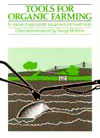 "Tools for Organic Farming -- A Manual of Appropriate Equipment and Treatments", George McRobie (editor), 1989, Practical Action, ISBN 1853390097
Small-scale and relatively affordable equipment for organic farmers, wherever they are in the world, with the emphasis on developing countries. Warns against chemical pesticides and describes how to use natural crop protection methods. Lists suppliers and manufacturers. The sustainable production system, Crop protection, Seed bed preparation and intercultivation, Sowing, planting, and fertilizer distribution, Harvesting and post-harvest crop processing, Appendix on water-lifting pumps and other equipment, Manufacturers' index. Buy from the Development Bookshop: Tools for Organic Farming
"Tools for Agriculture: A guide to appropriate equipment for smallholder farmers" by Ian Carruthers and Marc Rodriguez, 4th edition 1992, 270 pages, Practical Action, ISBN 185339100X
Unique guide to small-scale farming equipment. Each subject is introduced by an expert who sets the available tools against the background of good farming practise. Helps you evaluate what's most suitable for your situation. Analyses why some projects are successful and suggests ways to improve them. Land preparation, sowing and fertilizing, pest control, harvesting, water lifting, livestock care, beekeeping. With lists of manufacturers (mostly in the Third World). Download the complete book free from the CD3WD online 3rd World library (24.9Mb pdf):
http://www.fastonline.org/CD3WD_40/JF/417/06-256.pdf
Buy the book from the Development Bookshop: Tools for Agriculture
ECHO -- Educational Concerns for Hunger Organization -- A non-profit organization dedicated to the fight against world hunger. Focus on subsistence tropical agriculture, but for small farmers everywhere, or anyone with a garden. ECHO Technical Notes cover a broad range of topics, from beehives in the tropics to organic neem pest control. ECHO Development Notes (EDN) focus on tropical agriculture, techniques, plants, resources, to improve food production in the tropics. Also ECHO Appropriate Technology Notes, ECHO Plant Information Sheets, all free online in full text. ECHO's seed bank of tropical food, fuel, and soil-improving plants supplies seed of useful plants in small trial packets for experimentation in the field, seed catalog of unusual garden vegetables for sale (North America). ECHO Canada is a sister organization founded for and by Canadians.
http://www.echotech.org/
ATTRA -- Appropriate Technology Transfer for Rural Areas (US) concentrates on sustainable farming information. Large set of resource links on sustainable farming, from what-is to how-to, US focus. Online publications: Systems Guides, Technical Notes, Resource Lists, Farmer Profiles, Fundamentals of Sustainable Agriculture Series, Agronomy Series, Horticulture Series, Livestock Series, Pest Management Series, Soil and Fertility Series, Marketing & Business Series, Value-Added & Processing Series, Alternative Farming Systems Series, Resource Series, Planting Your Farm's Future Leaflets. Publication List:
http://www.attra.org/publication.html
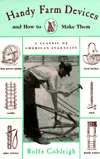 "Handy Farm Devices and How to Make Them" by Rolfe Cobleigh, Orange Judd Company, 1910
Not just nostalgia -- Cobleigh's devices and techniques were good answers to common farm problems and they're just as functional and useful now as they were then. Make your own workshop tools, a simple fence post and stump-puller, fences and gates that don't sag, building a farmhouse, barns and outbuildings, a bicycle-powered washing machine, a dog-powered pump, a lightweight orchard ladder, a portable chicken coop, a stone boat (for moving stone) and much more. Cobleigh's out to save you time and money -- a treasure for small farmers or homesteaders and anyone wanting to be more self-sufficient. Illustrated, good old-style writing, punctuated with quotes from Shakespeare or a local farmer, whichever's apt. Full text online in the Small Farms Library.
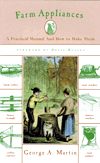 "Farm appliances and how to make them" by George A. Martin, 1887, Reprint edition 1999, The Lyons Press, ISBN 1558218882
Lots of useful gadgets and equipment, time-saving and easy-to-make, for the farm, garden, homestead -- wells and irrigation, a cart for breaking colts, a sheep-shearing bench and more, plus loads of tips and advice. Well illustrated with line drawings, and the usual clear, entertaining writing of the era -- bags of charm. Buy from Amazon.com: Farm appliances and how to make them
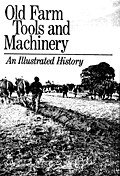 "Old Farm Tools and Machinery: An Illustrated History" by Percy W. Blandford, 1976, David & Charles, Devon, U.K., 191 p.
Well presented history, with photographs and clear line drawings of a wide range of farm tools of the previous era. Download the complete book free from the CD3WD online 3rd World library (11.9Mb pdf):
http://www.fastonline.org/CD3WD_40/JF/
417/06-250.pdf
Buy the book at Amazon.com: Old Farm Tools and Machinery
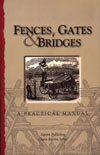 "Fences, Gates & Bridges -- A Practical Manual", George A. Martin, 1892, reprint in 1999, Algrove Publishing, ISBN 0-921335-62-8
This book predates the widespread use of wire fences, though there is a section on wire and barbed wire. It describes traditional fencing methods in detail, with excellent engravings and line drawings. Covers all kinds of fences, made of sod, stone, saplings, boards, pickets, a wide variety of hedges to contain animals, strong on gates, wide variety of styles and techniques for preventing sag, also wickets and stiles. The bridges are the small ones a small farmer might need. Buy from Amazon.com: Fences, Gates & Bridges
"Barn Plans & Outbuildings", Byron D. Halsted, Orange Judd Co, 1881, 1889 edition reprint 1999, Algrove Publishing, ISBN 0-921335-64-4
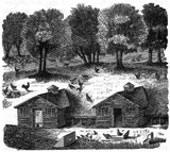
Hillside poultry house -- Barn Plans & Outbuildings
Excellent engravings, woodcuts and line drawings of the full range of farm buildings, from giant barns to dog kennels, many with floor plans and key construction information. General Farm Barns, Ice Houses, Dairy Houses, Corn Houses and Cribs, Cattle Shelters, Spring Houses, Sheep Barns and Sheds, Granaries, Etc., Poultry Houses, Root Cellars and Root Houses, Piggeries, Dog Kennels, Cattle Barns and Stables, Bird Houses, Smoke Houses, Ice Houses and Cool Chambers, Dairy Barns, Carriage Houses, The Preservation of Fodder in Silos -- very good section on making silage. Buy from Powell's Books:
http://www.powells.com/biblio/4-9780921335641-0
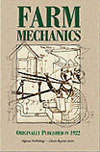 "Farm Mechanics" by Fred D. Cranshaw, 1922, Classic reprint Series.
Focuses more on general self-efficiency than on agricultural practice. When it was published farms had to be much more self-sufficient than today -- a farmer had to be familiar with woodworking, blacksmithing, concrete work, sheet metal work, farm machinery repair, and general rope and harness work. Covers a daunting range of subjects, using a straightforward approach to teaching the basics in each area using a wide range of examples. The book was used in agricultural extension courses of the day. Buy from Amazon.com: Farm Mechanics
Complete book free online at Cornell University's Core Historical Literature of Agriculture Library:
http://chla.mannlib.cornell.edu/cgi/t/text/text-idx?c=chla;idno=2840012
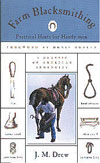 "Farm Blacksmithing: Practical Hints for Handy-Men" by James M. Drew, Denis Boyles, 2000, The Lyons Press, ISBN 1585740977
Time-honored instruction on all the essential skills of farm blacksmithing. Complete, no-nonsense guide first published a hundred years ago, covers both history and craft. Begins with the basics: how to set up a blacksmith shop, use of essential tools, selecting materials; goes on to a complete education in the most essential techniques. Step-by-step course in forging a wide variety of useful items from cutlery, candlesticks, and lanterns to horseshoes and handy farm devices. Illustrations throughout. Part of The Lyons Press series of authentic Americana from the turn of the century. Buy from Amazon.com: Farm Blacksmithing
Complete book free online at Cornell University's Core Historical Literature of Agriculture Library:
http://chla.mannlib.cornell.edu/cgi/t/text/text-idx?c=chla;idno=2734502
 Lehman's Non-electric -- "Serving the Amish and others without electricity with products for simple, self-sufficient living since 1955." Everything you need to go back to the land, from the people who never left it in the first place. Stuff here from all over the world -- German pressure lanterns, Chinese anvils, South African 3-legged cast-iron cooking pots, scythes from Austria, high-quality, along with built-to-last-forever goods made by local Amish craftsmen, lots of basic, sensible items you just don't find anywhere these days: "Products for Simple, Self-sufficient Living". Goods for the kitchen, appliances, stoves, water, lamps & lights, tools & farm, outdoors, home, plus online bookstore with books on cookery and preservation, health and nutrition, make it yourself, farming, animals, home and garden, country living, Amish and Mennonite. Order online. Site search.
http://www.lehmans.com/
Lehman's Country Life blog -- "The new and improved online simplicity village", user-powered community blog.
http://countrylife.lehmans.com/
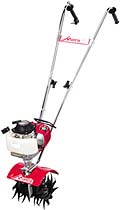 The Mantis lightweight tiller is not just a junior-sized toy cultivator, it's an effective tool that can do things a full-sized cultivator can't do, apart from working in much smaller spaces.
The Mantis weighs 20 pounds (9 kg). It was designed 30 years ago for professional landscape gardeners and it's the world's best-selling tiller, with more than a million sales.
The twisted "serpentine" tines spin at 240 RPM -- twice the speed of ordinary tillers, digging down to 10" (25cm), cutting through hard sod, compact soil or tough weeds, turning it all into finely textured soil ready for planting. The 9-inch (23cm) tilling width makes tilling or cultivating between rows easy.
The Mantis breaks sod and chops it up, incorporates organic matter, mixes in compost or lime, works soil in tight spaces, including raised beds, weeds between rows and among plants.
Switch the tines around and dig just a couple of inches into the soil to weed a large 30 x 40 ft garden (9 x 12 metres) in 20 minutes, chopping in the weeds as you go.
Available in three models: with an electric motor, a 2-cycle gasoline engine, or a Honda 4-cycle gasoline engine -- the Honda engine model is more powerful and quieter, it weighs 4 pounds more at 24 pounds (10.8 kg) and it's more expensive.
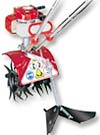 The attachments fit all three models: the Planter/Furrower has two special tines that dig deep, 6"-wide furrows in any soil -- for tomatos, corn, beans, potatoes, asparagus, onions, root crops, also for building raised beds and cutting trenches; the Plow attachment is propelled forward by the spinning tiller tines, you walk behind -- the hardened steel plow blade forms straight furrows, deep or shallow, much faster than working by hand, banks soil for planting; also Border Edger, Lawn Dethatcher, Lawn Aerator, Hedge Trimmer Bars, more.
"The Scythe Book" by David Tresemer, 1981, Reprint 1996, Alan C. Hood, ISBN 0-911469-14-1
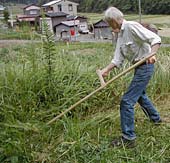
Clearing rough grass and weeds at our farm in Tamba, Japan -- we have two traditional European scythes from Slovenia, where local people still use scythes.
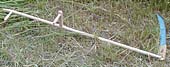
"In this age when most wonder how you can accomplish anything without the aid of electricity or gasoline, we must reassert that a hand tool finely made has greater versatility, has comparable efficiency even in large areas, and even makes for good exercise because the tool fits the dynamics of the body. Most importantly, a finely made tool does not interfere with personal communion with the ever-amazing natural world." A well-researched manual on the (almost) lost art of using a scythe: how to use a scythe with little effort. Tresemer delves into subjects such as the Alexander Technique, relaxation and mind-body techniques to explain the relaxed, natural swing that cuts the best -- Zen and the art of the scythe (though he doesn't say so). Interesting recounting of the history of the scythe (it took about 2,000 years to develop it). Includes sections on scythe maintenance and harvesting and processing small grains. A real pleasure to read. Download the complete book free from the CD3WD online 3rd World library (7.1Mb pdf):
http://www.fastonline.org/CD3WD_40/JF/417/06-273.pdf
Buy the book at Amazon.com: The Scythe Book
Scythe Supply offers high-quality European-style scythes, scythe blades, snaths, whetstones, hammers, anvils and equipment. "We are scythe enthusiasts and want others to discover this wonderful tool." Lots of content and a workshop section with how-to explanations and photos.
http://www.scythesupply.com/
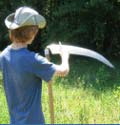 Marugg scythes -- "To our knowledge we our the only company in the U.S. still making curved hickory snaths for European style scythes." Marugg Blades are custom made by a company in Austria that has been making blades since 1540. "We are happy to report that a scythe renaissance is underway, as sustainable agricultural methods are adopted by farmers in the developed world and the internet brings availability of these awesome tools to the emerging nations. We ship worldwide. — Allen and Amy Wilson"
http://www.themaruggcompany.com/index.html
The Scythe Network, a co-operative group committed to promoting the use of the scythe. Technical and instructional arcticles online. Sells European blades, snaths, accessories online.
http://www.scytheconnection.com/
 "Outwitting Critters: A humane guide for confronting devious animals and winning" by Bill Adler, Jr., The Lyons Press
Dealing with "pests" in a compassionate, ecological style, by the best-selling author of Outwitting Squirrels, Outwitting Bears, and Outwitting Neighbors. Adler lists hundreds of tricks to fend off trespassers in this definitive guide for coping with the nettlesome side of nature. "Think like the critter you want to outwit. Get down on your hands and knees and look at the world from the animal's point of view." Roaches in the kitchen, deer in the garden, ants, raccoons or wasps, time-tested methods for humanely ridding your house and yard of unwanted critters. Buy from Amazon.com: Outwitting Critters
"Gardening for Better Nutrition" by Arnold Pacey, 1978, Women Ink, ISBN 0903031507
 Covers the basic technology of horticulture and vegetable-growing, mainly for family gardens in developing countries. Deals with the way vegetable growing has been encouraged by health service workers and nutritionists. It describes alternative kinds of agricultural extension work which are likely to meet the needs of women. Based on field reports and case histories. The second in a series of manuals on "Socially Appropriate Technology". Buy from Amazon.com: Gardening for Better Nutrition
"New Crops: Solutions for Global Problems" -- excellent article by Noel Vietmeyer of the New Crops project. "In Africa, where the hunger problem is concentrated, there are actually 2,000 species of native food plants. Both there and in the rest of the tropics, the region where malnutrition is severest, can be found 3,000 different fruits as well as over 1,000 vegetables. In the lands where deforestation is so destructive are to be found over 20,000 trees, some of them extremely fast growing. In the desertifying regions can be found many useful drought-tolerant plants -- I don't know how many, but it runs into the hundreds. Despite the existence of all this herbaceous heritage, hardly any tropical plant is being employed to full advantage to relieve the pervasive problems. Of Africa's 2,000 food plants, only sorghum gets major research. Of the 3,000 fruits, only banana and pineapple get solid global support, and again much of the effort is aimed at helping the rich rather than the needy. Of the 20,000 tropical trees, only a handful are undergoing global advancement. That the bulk of useful tropical biodiversity is underexploited is one of the glaring oversights of this era. The creation of more crops and the support for new-croppers is of global importance." Read on!
http://newcrop.hort.purdue.edu/newcrop/proceedings1996/V3-002.html
The New Crop Resource Online Program at Purdue University, includes CropSEARCH -- a key word search engine to access crop information, CropINDEX -- a list of scientific and common names of crops for information access, CropREFERENCE -- books and manuals on crops, Aromatic-MedicinalPLANTS -- a guide to aromatic & medicinal plants, culinary herbs and spices, NewCrop LISTSERV -- an interactive bulletin board for queries, discussion, and information on crops, and much more. Easy access to a huge set of resources on crops new and old, trees, plants of all kinds. "The most comprehensive library and compilation of new and alternative crop information available on the web." Very useful indeed.
http://www.hort.purdue.edu/newcrop/
 "Plants for a Future: Edible and Useful Plants for a Healthier World" by Ken Fern, 2000, Permanent Publications, ISBN 1856230112
The way we currently produce our food is damaging both to ourselves and our planet. We need to create gardens, woodlands and farms which are in harmony with nature. What we need is to discover and grow a wide variety of easily grown perennial and self-seeding annuals which provide delicious and healthy food, or are useful in other ways. Describing plants such as these, native to Britain and Europe and from temperate areas around the world, this book includes those suitable for: the ornamental garden, the edible lawn, shade, ponds, walls, hedges, agroforestry and conservation. Packed with information, personal anecdote and detailed appendices and indexes, this pioneering book takes gardening, conservation and ecology into a new dimension. "Ken Fern leads us through a garden of improbable delights -- cold climate yams five feet long, edible fuschia fruits, trees laden with delicious berries all through the winter, leaves and flowers with the most subtle and astonishing flavours. It is hard to over-estimate the importance and likely impact of this book. The result of an insatiable curiosity and years of painstaking research, this book is comparable in stature only to the works of Evelyn and Culpeper." -- George Monbiot, The Guardian. Buy from Amazon.com: Plants For A Future
Plants For A Future -- Database Search has a wide variety of powerful searches of very large plant resources. Search by Name (common or family), Edible, Medicinal or Other Use, Native Area, Habitat, word search, Latin names. You can download the database for your own use.
http://www.ibiblio.org/pfaf/D_search.html
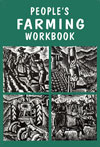 "People's Farming Workbook", Environmental and Development Agency Trust, 1995, David Philip, Cape Town, South Africa, ISBN 0 86486 112 5
For rural and resource-poor communities. The Workbook has obviously grown from the ground up, like a good crop: written by a collective, the authors know the needs of the grass-roots people the book targets. It's easy to read and easy to use, well-illustrated and well-organized to meet the needs of everyone from small farmers to backyard gardeners with little time and few resources. Simple without being simplistic, it's a mine of sheer usefulness -- an object-lesson for some of the expensive, top-heavy programs that set out to help poor rural people. Applicable anywhere in the Third World, not just South Africa. Buy from Amazon.com: People's Farming Workbook
First edition, the People's Workbook, by Robert Berold et. al., Environmental and Development Agency, Johannesburg, South Africa, download free from CD 3rd World online library, 41.7Mb pdf
http://www.fastonline.org/CD3WD_40/JF/410/02-76.pdf
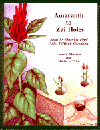 "Amaranth to Zai Holes: ideas for growing food under difficult conditions" by Laura S. Meitzner and Martin L. Price, 1996, ECHO (Educational Concerns for Hunger Organization). This book is an updated compilation of 15 years of ECHO's quarterly technical bulletin, ECHO Development Notes. "Amaranth is a drought-tolerant plant which provides both high-protein grain and delicious edible leaves. Zai holes use termites to improve soil fertility and increase water filtration in farmers' fields in West Africa. These are just two of the plants and techniques people are using to produce food under difficult growing conditions in the tropics." A treasurehouse of practical information for and from the field, mainly for people working with small farmers or urban gardeners in Third world settings -- new ideas, techniques, underutilized tropical plants, and offers of trial packets of seed to evaluate them. Full text free online:
http://www.echotech.org/technical/az/aztext/azcntnts.htm
Buy book from Amazon.com: Amaranth to Zai Holes
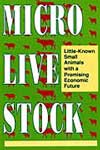 "Microlivestock: Little-Known Small Animals with a Promising Economic Future", 1991, Board on Science and Technology
Small animals require less feed and space and are easier to care for. This fascinating report makes suggestions for replacements for conventional livestock. Covers the microbreeds of cattle, goats, sheep, pigs, many breeds of poultry, rodents, deer, rabbits, lizards, and others, with appearance, distribution, habitat, biology, behaviour, care, pros and cons, and research needs. Read it online (free) or print it out at the National Academy Press:
http://www.nap.edu/books/030904295X/html/
Buy book from Amazon.com: Microlivestock
"Microlivestock" -- The Overstory #41
In many parts of the world the major protein sources are not "farm animals" but instead "microlivestock" -- small animals managed for food. There are over a thousand kinds of reptiles, rodents, insects, birds, and other small animals that can be categorized as microlivestock. Microlivestock have been essential to human nutrition for thousands of years. In the future, these small animals may be major players in food security, environmental conservation, and economic diversity.
http://www.agroforester.com/overstory/overstory41.html
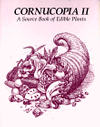 "Cornucopia II -- A Source Book of Edible Plants" by Stephen Facciola, Kampong, ISBN 0962808725
Encyclopaedia of about 3,000 edible plants, alphabetical listing of plant families with 300 pages describing 7,000 varieties, especially traditional and heirloom varieties, as well as promising new releases. Habitat, origin, cultivation, preparation, modern and ancient uses, and 1,300 sources for seed, plants and rootstock, produce and other foodstuffs. In addition to common and botanical name cross-referencing there is an index of plants listed by use and edible parts. Wonderful work of scholarship. Buy from Amazon.com: Cornucopia II
 "Controlling Crop Pests and Diseases", Rosalyn Rappaport, Practical Action; New Edition (1999), ISBN 9781853396007
Covers pest and disease damage, causative agents, and methods of combatting them. As well as manual and cultural techniques, it shows that expensive chemicals are not necessary -- the secrets of cheaply-available or improvised ingredients are revealed. Also covers protection against larger animals and wind, using hedges and ditches. The examples are illustrated stories presented as strip cartoons for extension staff or teachers to show and hand out to farmers and students. Buy from the Development Bookshop: Controlling Crop Pests and Diseases
See also:
Small farms
Small farms library
City farms
Organic gardening
Composting
Appropriate technology
Appropriate technology resources
- Agriculture resources
- Wood resources
Blacksmithing
Wood fires that fit
Houses that fit
Water-powered water pumps
Journey to Forever and AT
- Chinese watering cans
- Handmade Projects watering can plans
- Hoe for victory!
- Billhooks and sickles
A better rat trap
- Rats and owls
- Chinese rat trap
- How to make a Chinese rat trap
- Bucket rat trap
Appropriate technology subjects
